
Luxury Kitchen Storage Solutions: Smart Interiors & Space Use


Storage in a well-designed kitchen is never resolved at the end of the process. It is built into the thinking from the start, shaped by how you move, what you cook, and what daily life in that space actually demands.
This guide covers the cabinet organisation, drawer systems, pantry configurations and open shelving decisions that make a kitchen genuinely functional, the kind of detail worth understanding before you brief a designer, so that the conversations you have are the right ones.
The Thinking Behind How a Kitchen Is Organised
In a kitchen planned with care, every centimetre of internal space is accounted for. The goal is not simply to fit things in, but to make retrieval effortless, surfaces calm, and the interior of each cabinet as considered as the exterior. When storage is approached this way, it stops being a practical afterthought and becomes part of the design itself.
Considered internal fittings are barely noticed in use. Drawers open quietly and close without effort. Pantry doors reveal orderly shelving. Corner units rotate to bring everything within reach. When these details are right, the kitchen settles into a kind of ease that is difficult to attribute to any single element, because it comes from all of them working together.
How to Organise Kitchen Cabinets for Maximum Efficiency
The principle that underlies every well-planned cabinet layout is straightforward: things should be stored where they are used. A kitchen designed around this idea allocates internal space according to how the space is actually worked, not how a generic floor plan happens to fall.
Zone-Based Cabinet Organisation
A considered kitchen is planned in functional zones, with storage allocated accordingly. When briefing a kitchen design, it is worth being specific about how each zone operates in your household:
- Cooking zone: pans, lids and cooking utensils in deep drawers or pan pull-outs adjacent to the hob
- Prep zone: chopping boards, mixing bowls and small appliances close to the primary worktop area
- Baking zone: trays, rolling pins and baking ingredients grouped in a dedicated cabinet or larder unit
- Crockery and glassware: wall cabinets or tall units positioned near the dishwasher for straightforward unloading
- Cleaning supplies: a base cabinet beneath or beside the sink with pull-out bin and cleaning product storage
The more precisely this is established at the briefing stage, the more purposefully the internal specification can be drawn up.
How to Arrange Kitchen Cabinets: Interior Fittings That Make the Difference
Zone planning determines where things live. The internal fittings specified determine how well that organisation holds up over years of daily use:
- Pull-out shelves and carousels: bring the back of deep base cabinets into easy reach without having to unload the front
- Dividers and inserts: keep stacked plates stable, prevent lids migrating, and hold the order that was designed in
- Soft-close hinges and push-to-open mechanisms: a detail that changes the quality of every interaction with the kitchen
- Vertical dividers: the right solution for baking trays, chopping boards and large flat items stored upright
- Integrated lighting: LED strip lighting inside cabinets makes contents immediately visible when doors are opened, integrated during manufacture for a clean result
How to Organise Kitchen Drawers
In a considered kitchen, deep drawer banks have largely replaced lower base cabinets, and with good reason. Drawers give full visibility of everything inside at a glance, without bending or rummaging. It is a shift that is most cleanly resolved at the design stage when drawer heights, depths and internal configurations can be specified together.
The Three-Drawer Stack System
A bank of three drawers works best when each level is assigned by frequency of use, a logic that should inform the internal specification from the outset:
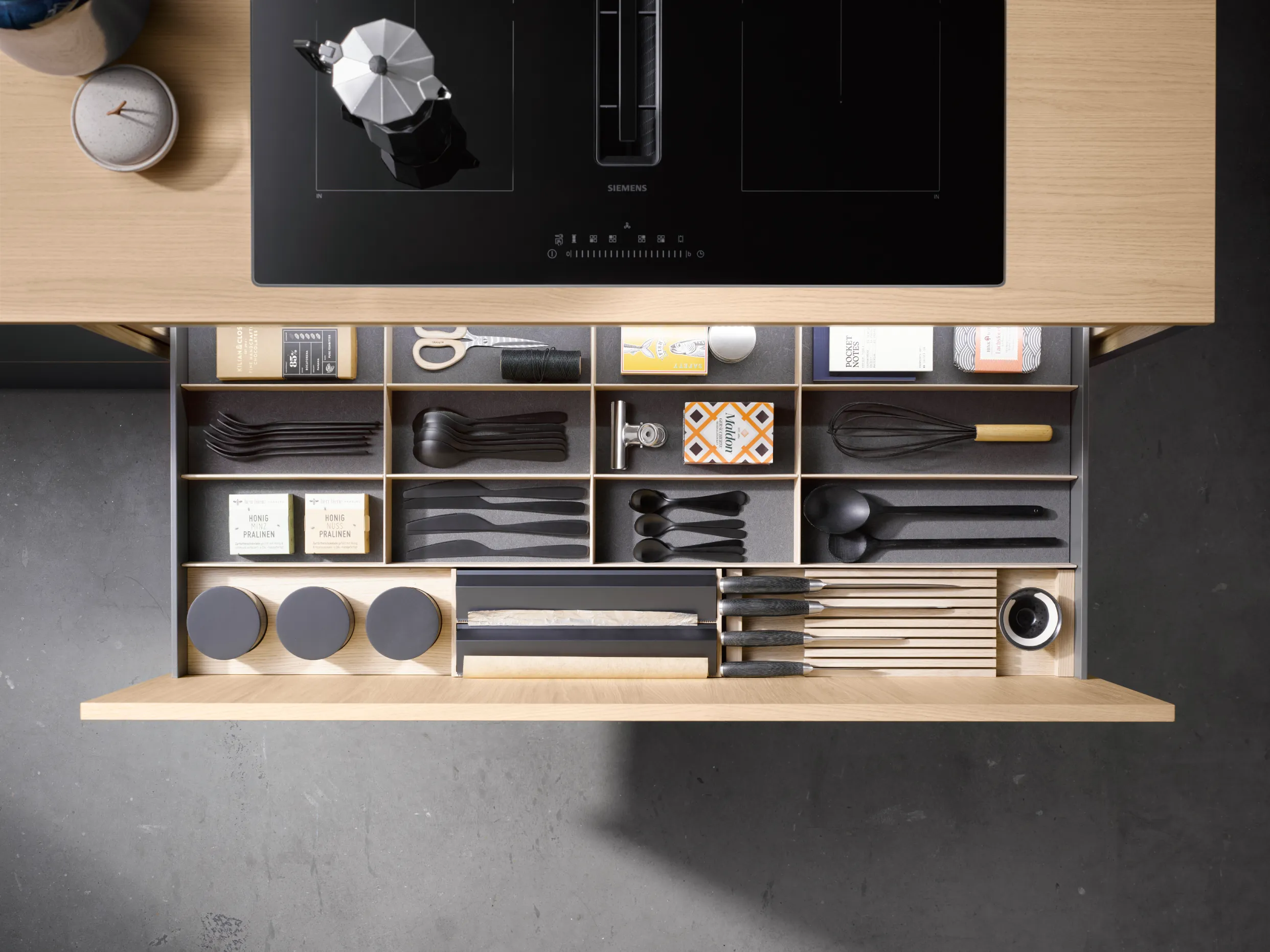
- Top drawer (everyday): cutlery, serving spoons and frequently reached utensils, fitted with a wooden or stainless-steel insert made to the drawer’s exact dimensions
- Middle drawer (regular): cooking tools, peelers, graters and items reached several times a week
- Deep bottom drawer (occasional): pans, large lids, colanders and items used less frequently
Bespoke Drawer Inserts
In a kitchen designed to this standard, drawer inserts are made to measure, in solid oak, walnut or stainless steel, rather than adapted from off-the-shelf solutions. Knife blocks built into the drawer at an angle protect blades and keep them immediately accessible. Angled spice inserts bring order to what is typically the most chaotic drawer in any kitchen. Plate peg systems in deep drawers hold crockery securely and prevent chipping during use.
The value of bespoke inserts is in their precision. Fitted to the exact internal dimensions of each drawer, they use every millimetre deliberately. The organisation they create is maintained without effort, which is the point.
How to Organise Your Kitchen Pantry
A well-designed pantry is among practical features a kitchen can include. Whether it takes the form of a walk-in room, a tall larder unit or a pull-out tower, the design principles are the same: everything visible, everything accessible, and every category in a fixed location so the pantry stays organised without constant management.
Pantry Organisation by Category
The internal configuration of a pantry should be established during the kitchen design, allocating shelf heights, depths and pull-out positions according to what is actually stored. A well-specified pantry assigns each category its own zone:
- Everyday staples: eye-level shelves for oils, condiments and frequently used tins, immediate reach, no searching
- Dried goods: mid-level shelving for pasta, rice and grains, often decanted into matched containers for a consistent appearance and easier stock management
- Baking ingredients: a dedicated shelf for flour, sugar and raising agents, with appropriate container depths specified at the design stage
- Snacks and cereals: an upper section accessible to different household members independently
- Bulk and overflow stock: lower shelves for heavier items and reserves, accessed less frequently and positioned accordingly
Larder Units and Pull-Out Pantry Solutions
For kitchens without a dedicated pantry room, a tall larder cabinet with internal pull-out shelving, or a full-extension pantry pull-out, delivers considerable storage within a single unit footprint. These fittings glide out to reveal multiple tiers of shelving, wire baskets and door-mounted racks, bringing every item into full view. A single 600mm pull-out can hold as much as two standard base cabinets, a significant gain in a kitchen where floor area is fixed.
What to Put on Open Kitchen Shelves
Open shelving is a design decision as much as a storage one. The choice to include it, and where, should be resolved alongside the cabinet layout, not treated as a styling option to be added later. When it is integrated into the design with intention, open shelving creates a sense of openness and allows the kitchen to carry some of the character of the objects that are used in it. When it is an afterthought, it becomes a surface that is difficult to maintain.
Items That Work Well on Open Shelves
The things that belong on open shelving are those that are both functional and worth displaying:
- Glassware: matching glassware and wine glasses, uniform, elegant and easy to reach
- Ceramics and stoneware: serving bowls, jugs and quality crockery that earns a place in the design
- Cookbooks: a curated selection adds warmth and personality without visual noise
- Decanted staples: glass canisters or ceramic containers for pasta, pulses, tea and coffee, considered and settled in appearance
- Plants and herbs: a small potted herb collection or a single architectural plant
- Chopping boards: quality wood or marble boards, stacked or propped upright
What to Avoid on Open Kitchen Shelves
Open shelving rewards restraint and consistency. Anything visually mismatched, difficult to keep clean or frequently displaced belongs behind a door. The discipline of deciding what stays visible, and what does not, is part of what open shelving asks of a kitchen design. It is worth considering this during the planning stage, rather than discovering it after installation.
How Open Shelves Work Within a Kitchen Design
Open shelves function best when they are positioned and proportioned deliberately, not simply wherever a wall cabinet might otherwise have gone. Their depth, height and relationship to adjacent cabinets all affect how they read within the overall composition. In a Häcker kitchen, open shelf positions are considered alongside the full interior specification: the materials, the object types that will live there, and the visual balance with closed storage around them. The result is shelving that feels like part of the design, not an addition to it.
Smart Interior Fittings for Kitchen Storage
The quality of a kitchen’s internal fittings is felt before it is understood. When you open a drawer, nothing should rattle, stick or require effort. These are the fittings that distinguish a considered kitchen specification from a standard one:
- Full-extension drawer runners with integrated soft-close: drawers open completely to reveal their full depth and close quietly without being pushed
- Magic corner and carousel units: purpose-built for corner base cabinets, eliminating the dead space that conventional corner units leave behind
- Pull-out waste and recycling units: segregated bins contained within a cabinet, operated with a single door-pull, waste management that does not impose itself on the kitchen
- Motorised lift systems for wall cabinets: electronic lift-up doors that rise with a light touch, particularly useful for tall wall units above eye level
- Integrated appliance garages: a roller-shutter cabinet section that conceals stand mixers, coffee machines and regularly used appliances, accessible without cluttering the worktop
- Illuminated interiors: LED lighting activated when doors or drawers open, a detail that changes the daily experience of every interaction with the kitchen
Frequently Asked Questions
How do I organise kitchen cabinets to keep them tidy?
Reliable kitchen storage is designed around how the space is actually used, zones, frequencies, proximities, rather than retrofitted with organisational effort. When those decisions are made at the design stage and the internal fittings are specified accordingly, the result is a cabinet layout that maintains its order without requiring constant management.
How should I arrange kitchen cabinets for the best workflow?
Storage should follow the working triangle, sink, hob, fridge, with each category of item allocated close to where it is used. Pans near the hob, prep equipment near the worktop, crockery near the dishwasher. The more specifically this logic is established during the design brief, the more purposefully the cabinet layout can be drawn up.
What is the best way to organise kitchen drawers?
Deep, full-extension drawers with bespoke inserts made to the exact internal dimensions of each drawer. Organised by frequency of use from top to bottom, with each category given its own fixed position. The internal specification should be decided alongside the drawer heights and depths, not after the kitchen is built.
How do I organise a kitchen pantry effectively?
A well-considered pantry layout is resolved during the kitchen design: shelf heights, pull-out depths and door-mounted positions all specified in relation to what will actually be stored. A pantry designed around the household’s real inventory, with everyday items at immediate reach and reserves at lower levels, will function without constant reorganisation.
What should I put on open kitchen shelves?
Objects that are both functional and worth displaying: matching glassware, quality ceramics, cookbooks, decanted staples in considered containers, chopping boards and a plant or two. The more important question is whether open shelving is the right design choice for a given wall, and how it relates to the closed storage around it, decisions best worked through during the design process.
Is a pull-out pantry better than a walk-in pantry?
Both serve different purposes. A walk-in pantry offers greater capacity and can function as a room in its own right. A pull-out unit delivers considerable storage within a single unit footprint and brings every item into direct reach. In larger Häcker kitchens, both are sometimes used together: a pull-out tower for everyday staples, a walk-in for bulk storage and appliances. The right answer depends on the floor plan and how the kitchen is used.
Storage That Earns Its Place
The internal organisation of a kitchen is not a finishing detail. It shapes how the kitchen feels to work in every day, how calm the surfaces remain, how effortlessly things are found, how well the space holds its order over time. These decisions are most effectively made at the design stage, where storage depths, fitting specifications and zone logic can be resolved together rather than separately.
If you are in the early stages of planning a kitchen or want to understand what a well-specified storage scheme would look like for your space, our design team can work through it with you. You are welcome to speak with a designer or visit the Dubai studio.
Read More
![JBR Kitchen- Sepide Uhlmann]()
Kitchen Worktops & Backsplashes: Materials, Performance & Style
Learn MoreWorktops and backsplashes sit at the point where appearance and performance meet. They ...
![]()
Choosing Kitchen Colours: Timeless Palettes for Luxury Homes
Learn MoreColour is one of the first things people respond to in a kitchen. Before you notice sto...


Create a kitchen that is as individual as you.
German crafted, Exquisite Häcker Kitchen is waiting just for you.
Speak to Our Designers Now!