
Kitchen Cabinet Guide: Construction, Types & Premium Options


It’s usually the small things that give a poorly-designed kitchen away. Reaching for something that isn’t where it should be. A drawer that doesn’t quite glide. A surface that never seems to stay clear. Individually, they’re minor. Together, they shape how the kitchen feels to use, every single day.
Cabinetry and construction sit quietly behind all of this. When it’s right, you don’t notice it. When it’s wrong, you feel it constantly.
A well-designed kitchen isn’t just about how it looks; it’s about how it supports your routine. How it holds everything in the right place, how it moves with you, how it continues to work years after installation.
Häcker kitchens are built around that idea. German-engineered, designed for real use, and adapted for the UAE through tropicalised cabinetry, each kitchen is created to perform consistently over time — backed by a 20-year warranty.
Kitchen cabinet types and the lives they’re designed for
Every cabinet type exists for a reason. Not as a category, but as a response to how a kitchen is used. The right combination depends on how you cook, how you move through the space, and how you want the kitchen to feel within your home.
Base cabinets
Base cabinets carry the rhythm of daily life. They’re opened constantly, used without thinking, and relied on for everything from prep to storage. The difference is in how they’re configured. Deep drawers bring everything into view at once, reducing the need to reach or search. Traditional cupboards, while familiar, often hide more than they reveal.
In a busy household, this becomes immediately noticeable. A well-designed base cabinet makes cooking feel smoother, more intuitive, less like a task and more like a well thought out flow.
Wall cabinets
Wall cabinets do more than offer storage solutions, they shape the room and define the atmosphere. In smaller kitchens, they keep surfaces clear and usable. In larger, open-plan spaces, they influence how the kitchen feels as part of the wider interior.
Full-height runs create a sense of structure and alignment. Open shelving introduces lightness but requires discipline. Glass-fronted cabinets strike a balance, adding depth without visual weight.
Tall and larder cabinets
Tall cabinetry changes how a kitchen is experienced. A well-placed run of full-height cabinets brings order to the space, consolidating storage and integrating appliances into a single, cohesive zone.
For households that cook regularly, larder systems become particularly valuable. Everything is visible, accessible, and contained — no searching, no clutter spreading across surfaces. For others, it’s about calm. The ability to close everything away behind a continuous surface, leaving the kitchen feeling composed.
Corner cabinets
Corners are where most kitchens lose space, and where frustration tends to build. Without the right solution, they become areas you avoid. Hard to reach, poorly lit, and rarely used properly.
With the right system, they do the opposite. Pull-out mechanisms, carousel units, and engineered corner solutions bring everything forward, making storage fully accessible. It’s one of those changes that seems small but completely shifts how the kitchen works.
Handleless cabinets
Handleless cabinetry changes how a kitchen reads. Without handles breaking the surface, everything feels more continuous, more composed, particularly in open-plan homes where the kitchen is always in view.
It also changes how the space is maintained. Fewer interruptions mean easier cleaning and a quieter visual result.
Behind that simplicity, however, is precision. The system you choose — whether J-pull, grip channel, or push-to-open — affects how the kitchen behaves day to day. When done well, it feels effortless. When it’s not, you notice it immediately.
Bespoke kitchen cabinets
Bespoke cabinetry starts with the space, not the product. Every home has its constraints and unique design featured, from a ceiling that drops to a wall that shifts, or a column that sits where you’d rather it didn’t. Standard kitchen cabinet sizes and designs can only go so far.
Bespoke design resolves these moments properly. Dimensions are adjusted to the millimetre, finishes are selected for the space, and internal layouts are built around what will actually be stored.
In Dubai homes, where layouts are rarely uniform, this often isn’t a luxury, it’s the only way to achieve a premium and quality-led kitchen design that preforms as well as it looks.
Kitchen cabinet sizing and why precision changes everything
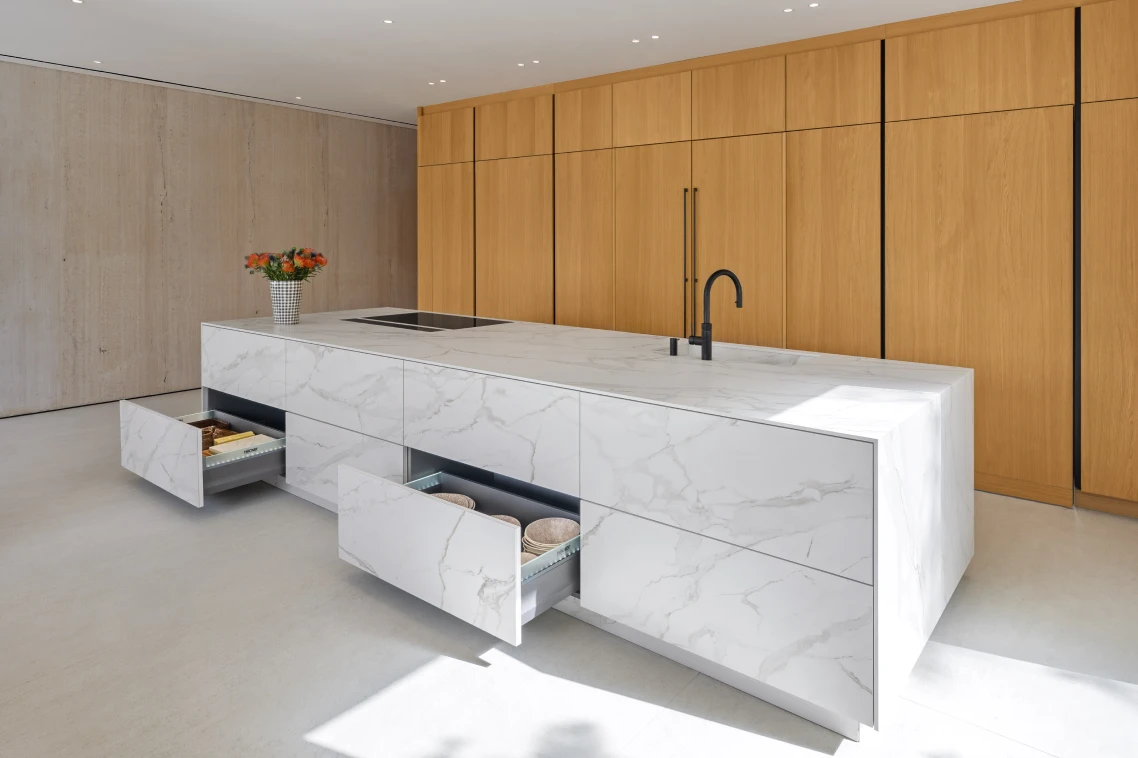
Cabinet sizing isn’t something you consciously notice — until it’s wrong. A kitchen can look well designed on the surface, but if proportions are slightly off, it never feels quite right. Worktops sit too high or too low, cabinets don’t align cleanly, or small gaps interrupt what should be continuous surfaces. These are subtle details, but they shape how the entire space is experienced.
In a considered kitchen, sizing is not about fitting cabinets into a room. It’s about designing the kitchen to sit perfectly within the space: visually, proportionally, and functionally.
Why standard cabinetry sizing isn’t enough for a premium kitchen
Standard cabinet dimensions exist for efficiency, not precision. They are designed to work across a wide range of spaces, which means they rarely resolve a specific space perfectly. This is where many kitchens begin to feel slightly compromised, including filler panels, uneven lines, or proportions that don’t quite align with the architecture.
In a custom-designed kitchen, sizing is approached differently. Cabinetry is planned in relation to the space itself, ensuring every element aligns cleanly and feels intentional.
Designing cabinetry around your space and lifestyle
True kitchen design begins with how the space is used. Cabinet heights are adjusted for comfort and reach. Depths are considered in relation to movement and access. Storage is configured around use and functionality, not what standard units allow.
In Dubai homes, where layouts are often open-plan and architectural features play a larger role, this level of precision becomes even more important.
The result is a kitchen that doesn’t feel fitted into place, but fully integrated, designed around both the space and the people living in it.
How much do Häcker custom kitchen cabinets cost?
Cost is always part of the conversation, but it’s rarely just about the number. Different materials and levels of construction sit across different tiers, from high-end options through to bespoke, fully integrated cabinetry and premium designs.
What matters is what that cost delivers over time. A kitchen used daily for twenty years carries a different value than one replaced after five. When construction, materials, and warranty are factored in, the question becomes less about upfront cost, and more about long-term performance and use.
FAQs
What makes Häcker kitchen cabinets different from standard kitchens?
Häcker kitchens are not built around standard modules or off-the-shelf configurations. Each kitchen is designed as a complete, integrated system, tailored to the space, the architecture, and how it will be used.
This approach allows for a level of precision that goes beyond appearance. Cabinetry aligns exactly, proportions feel intentional, and internal layouts are designed around real storage needs rather than fixed formats.
Combined with German engineering and tropicalised construction for the UAE climate, the result is a kitchen that performs as consistently as it looks — over years of daily use.
What are the different types of kitchen cabinets?
Kitchen cabinetry is typically grouped into base, wall, tall, and corner units, but in a Häcker kitchen, these are not treated as fixed categories.
Instead, they are combined and adapted to suit the space. Storage is planned around how the kitchen will be used, not predefined layouts — whether that means integrating full-height cabinetry for a seamless look, creating hidden storage behind continuous surfaces, or opening up sections to introduce light and balance.
The focus is not on the types themselves, but on how they work together as part of a considered design.
Which kitchen cabinets are best for a small kitchen?
In smaller kitchens, the goal is not simply to fit more in, but to create a space that feels clear, usable, and well resolved. This often means using full-height cabinetry to maximise vertical storage, handleless designs to reduce visual interruption, and drawer-based systems to improve access and organisation.
Rather than relying on smaller units, Häcker kitchens approach compact spaces with the same level of design consideration, ensuring the kitchen feels intentional, not constrained.
Why is a 20-year kitchen warranty important?
A kitchen is used every day, often multiple times a day, which means performance over time matters as much as initial design.
Häcker’s 20-year warranty reflects the confidence in its engineering, materials, and construction standards. It’s not simply a guarantee, but an indication that the kitchen is built to maintain its structure, alignment, and finish over the long term.
In a climate like the UAE, where heat and humidity place additional demands on cabinetry, this level of assurance becomes even more relevant.
Can kitchen cabinets be made to a custom size?
Häcker kitchens are designed to fit the space precisely, rather than adapting the space to standard cabinet dimensions. Every element — from cabinet height to internal configuration — is tailored to the room and how it will be used.
This ensures alignment across the entire kitchen, eliminates unnecessary gaps, and creates a more resolved overall design. Custom sizing is not an add-on, but a fundamental part of how the kitchen is planned.
Are German-engineered kitchen cabinets better quality?
German kitchen manufacturing is defined by precision, consistency, and long-term performance. For Häcker, this means every cabinet is produced within a controlled factory environment, using high-spec materials, advanced machinery, and rigorous quality standards. The result is cabinetry that aligns perfectly, operates smoothly, and maintains its performance over time.
When combined with tropicalised construction for UAE conditions, this level of engineering ensures the kitchen is built not just for installation, but for everyday life over many years.
Start your kitchen cabinet journey with Häcker Dubai
A well-designed kitchen doesn’t draw attention to itself. It simply functions seamlessly in your everyday life.
Built using tropicalised cabinetry, German-engineered for the UAE, and backed by a 20-year warranty, every Häcker kitchen is designed to perform as well as it looks — long after installation.
Visit the Häcker Dubai showroom or book your consultation to explore what’s possible for your space.
Read More
![JBR Kitchen- Sepide Uhlmann]()
Kitchen Worktops & Backsplashes: Materials, Performance & Style
Learn MoreWorktops and backsplashes sit at the point where appearance and performance meet. They ...
![]()
Choosing Kitchen Colours: Timeless Palettes for Luxury Homes
Learn MoreColour is one of the first things people respond to in a kitchen. Before you notice sto...


Create a kitchen that is as individual as you.
German crafted, Exquisite Häcker Kitchen is waiting just for you.
Speak to Our Designers Now!